

Law firm growth takes more than bringing in new clients. A firm can have a steady stream of inquiries and still struggle if client communication slips, the legal work runs behind, or the back office can’t keep up. Sustainable growth depends on several functions working together.
One useful way to think about those functions is the finders, minders, grinders, binders framework. Each term describes a role that contributes differently to how a firm operates and grows:
- Finders bring in new business.
- Minders build and maintain client relationships.
- Binders keep the firm organized and running.
- Grinders deliver the legal work.
In a small firm, one person often performs several of these roles at once. In a larger firm, they may be spread across attorneys, marketing professionals, legal support staff, and operations leaders. Either way, understanding the roles helps you see where your firm is strong, where it has gaps, and where law firm marketing fits into the bigger picture.
What Are Finders, Minders, Binders and Grinders?
The terms are shorthand for the four main functions behind a growing practice. You’ll sometimes see the framework written as “finders, minders, and grinders,” with binders added as a fourth role for operations. Here’s a quick overview:
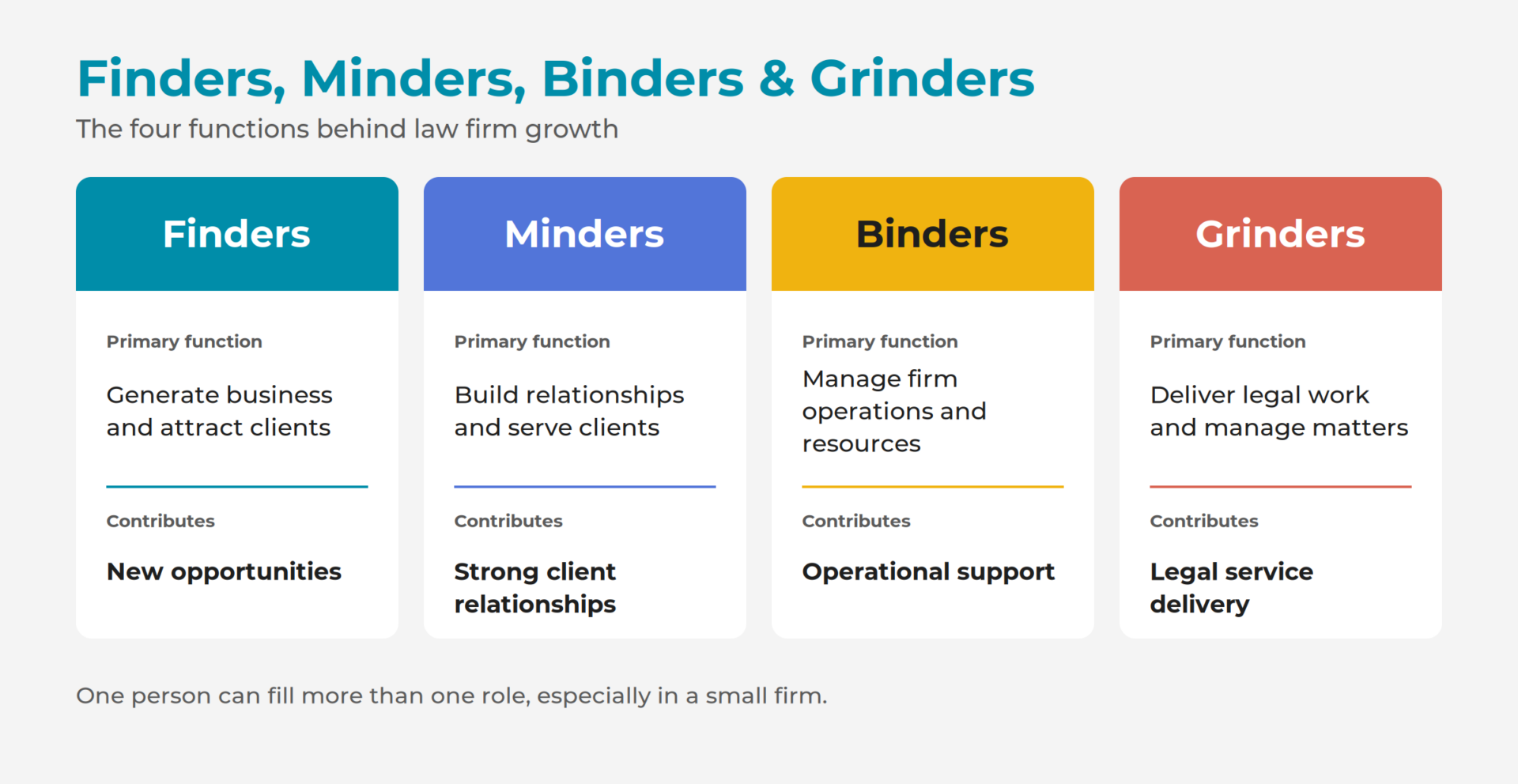
These are functional roles, not necessarily four separate job titles. A single attorney might be a finder on Monday, a grinder on Tuesday, and a binder on Friday afternoon when the invoices need attention.
Finders: The People Who Bring in New Business
Finders generate opportunities. They are the reason the phone rings, the consultation calendar fills up, and new matters come through the door. Typical finder activities include:
- Business development: Identifying and pursuing new client opportunities.
- Networking: Building connections at events, associations, and industry groups.
- Referrals: Cultivating relationships with other attorneys, professionals, and past clients who send work your way.
- Community involvement: Showing up in the community the firm serves.
- Thought leadership: Sharing expertise through articles, presentations, and commentary.
- Speaking opportunities: Presenting at conferences, CLEs, and local events.
- Relationship building: Staying in touch long before someone needs a lawyer.
- Digital marketing: Making the firm easy to find and easy to trust online.
Marketing supports the finder role, but it doesn’t replace it. A strong website and search presence can put your firm in front of the right people, yet many legal clients still choose a lawyer based on a personal recommendation. The best approach pairs relationship-based referrals with a consistent marketing program, so people who hear your name can quickly find and verify your firm.
Minders: The People Who Build Client Relationships
Minders look after clients once they’ve arrived. They make sure people feel informed, heard, and well served throughout the matter and after it closes. Key minder responsibilities include:
- Client communication: Providing regular, clear updates.
- Responsiveness: Returning calls and emails promptly.
- Understanding client goals: Knowing what the client actually wants to achieve.
- Managing expectations: Being honest about timelines, process, and uncertainty.
- Client retention: Keeping clients for future matters.
- Cross-practice referrals: Connecting clients with colleagues in other practice areas.
- Long-term relationships: Staying connected after the file is closed.
Attracting a client is only the first step. Satisfied clients return with new matters and refer friends, family, and colleagues. A firm that invests heavily in finding new clients but neglects the ones it already has is working harder than it needs to.
Binders: The People Who Keep the Firm Organized
Binders build and maintain the infrastructure behind the practice. They rarely get credit, but a firm’s ability to grow without chaos depends on them. Binder responsibilities include:
- Financial management: Billing, collections, budgeting, and trust accounting.
- Administrative processes: The routine tasks that keep the office moving.
- Technology: Practice management software, document systems, and security.
- Staffing: Hiring, training, and scheduling the right people.
- Workflow: Defining how matters move from intake to completion.
- Scheduling: Managing calendars, deadlines, and resources.
- Document management: Keeping files organized, searchable, and secure.
- Compliance and internal procedures: Following ethical rules, regulatory requirements, and firm policies.
Operational efficiency matters because growth adds complexity. More clients, more matters, and more staff all create more moving parts. Without solid systems, growth can produce missed deadlines, billing delays, and frustrated employees rather than better results.
Grinders: The People Who Deliver the Legal Work
Grinders do the substantive legal work at the core of the practice. Their responsibilities include:
- Legal research: Finding and analyzing the relevant law.
- Drafting: Preparing pleadings, contracts, motions, and correspondence.
- Case preparation: Building the strategy and assembling the record.
- Matter management: Tracking tasks and progress across active files.
- Court preparation: Getting ready for hearings, depositions, and trial.
- Document review: Examining materials carefully and accurately.
- Meeting deadlines: Delivering on time, every time.
- Quality control: Checking the work before it goes out the door.
Strong legal work supports everything else. Clients who receive careful, timely service are more likely to stay, refer others, and speak well of the firm. A reputation for quality also makes the finder’s job easier, because it gives referral sources confidence when they recommend you.
Why All Four Roles Matter to Law Firm Growth
Rather than focusing only on acquiring clients, it helps to see how the four functions feed one another:
- Finders → New opportunities
- Minders → Strong client relationships
- Grinders → Legal service delivery
- Binders → Operational support
Weakness in one area tends to spill into the others. If finders bring in more work than grinders can handle, quality and deadlines suffer, which hurts the minders’ relationships and eventually the firm’s reputation. If binders don’t maintain good intake and billing systems, finders’ leads get lost and grinders spend time on administrative tasks. Growth works best when the four functions move together.
What Happens When a Law Firm Relies Too Heavily on One Role?
Imbalance is common, and it usually shows up in predictable ways:
- Too many finders: The firm generates business but may struggle with service capacity.
- Too many grinders: The firm may deliver excellent legal work but lack consistent business development.
- Weak minders: Client communication and retention may suffer.
- Weak binders: Administrative inefficiencies can limit scalability.
None of these is a criticism of the people involved. It’s a sign of where the firm may need to invest, delegate, or add support.
How the Four Roles Change as a Law Firm Grows
The balance among roles shifts as a practice matures.
Small firm. Individuals wear multiple hats. The founding attorney may market the firm, meet with clients, do the legal work, and handle the books. Flexibility is an advantage here, but time is the constraint.
Growing firm. Responsibilities begin to specialize. One attorney focuses on business development, an office manager takes over operations, and associates handle more of the legal work. Processes become increasingly important, because what once lived in one person’s head now needs to be documented.
Established firm. Business development, client management, legal delivery, and operations may each have dedicated leaders or teams. The challenge shifts to coordination, making sure the groups share information and work toward common goals.
Solo and small practices face the most role-juggling. If that describes your firm, these marketing ideas for solo and small law firms can help you prioritize your limited time.
How Law Firm Marketing Supports the Finder Role
Marketing can create visibility and open doors, while attorneys and business-development professionals remain responsible for relationships and conversion. Practical marketing activities that support finders include:
- SEO: Helping potential clients find your firm when they search for legal help.
- Local SEO: Strengthening your visibility for searches tied to your city or region.
- Content marketing: Publishing useful articles and guides that answer real client questions.
- Website optimization: Making sure your site is fast, clear, and built to turn visitors into inquiries.
- Reputation management: Encouraging and responding to client reviews.
- Email marketing: Staying in touch with past clients and referral sources.
- Social media: Sharing news, insights, and firm culture.
- Paid advertising: Reaching targeted audiences when it fits your goals and budget.
- Thought leadership: Positioning your attorneys as knowledgeable voices in their practice areas.
People increasingly ask AI tools for recommendations too, so it’s worth thinking about AI search optimization as part of your visibility plan.
Remember that legal advertising is regulated. Make sure your marketing follows the rules in your jurisdiction, particularly on claims, testimonials, and outcome statements.
Law Firm Growth Strategies Based on the Four Roles
Here are practical steps you can take to put the framework to work:
- Identify which roles are currently strongest. Be honest about where your firm shines.
- Find gaps in business development and client service. Look for where opportunities or relationships are slipping.
- Document operational processes. Write down intake, billing, and matter workflows so they don’t depend on one person.
- Track where new clients originate. Knowing your best referral and lead sources tells you where to invest.
- Improve client communication. Set standards for update frequency and response times.
- Develop a consistent marketing strategy. A documented law firm marketing strategy keeps your efforts focused rather than reactive.
- Measure workload and capacity. Make sure you can serve the clients you attract.
- Review responsibilities as the firm grows. Revisit who does what at least once a year.
How to Identify Which Role Needs More Attention
Ask yourself and your team:
- Are we generating enough qualified leads?
- Are existing clients receiving consistent communication?
- Are administrative processes slowing the team down?
- Are attorneys spending too much time on non-billable tasks?
- Are marketing leads being followed up with?
- Do we have enough capacity to handle new matters?
If the answers point to a pattern, such as strong leads but slow follow-up, you’ve likely found where to focus first.
Metrics Law Firms Can Track for Growth
What you measure tends to improve. Consider tracking a few metrics for each role.
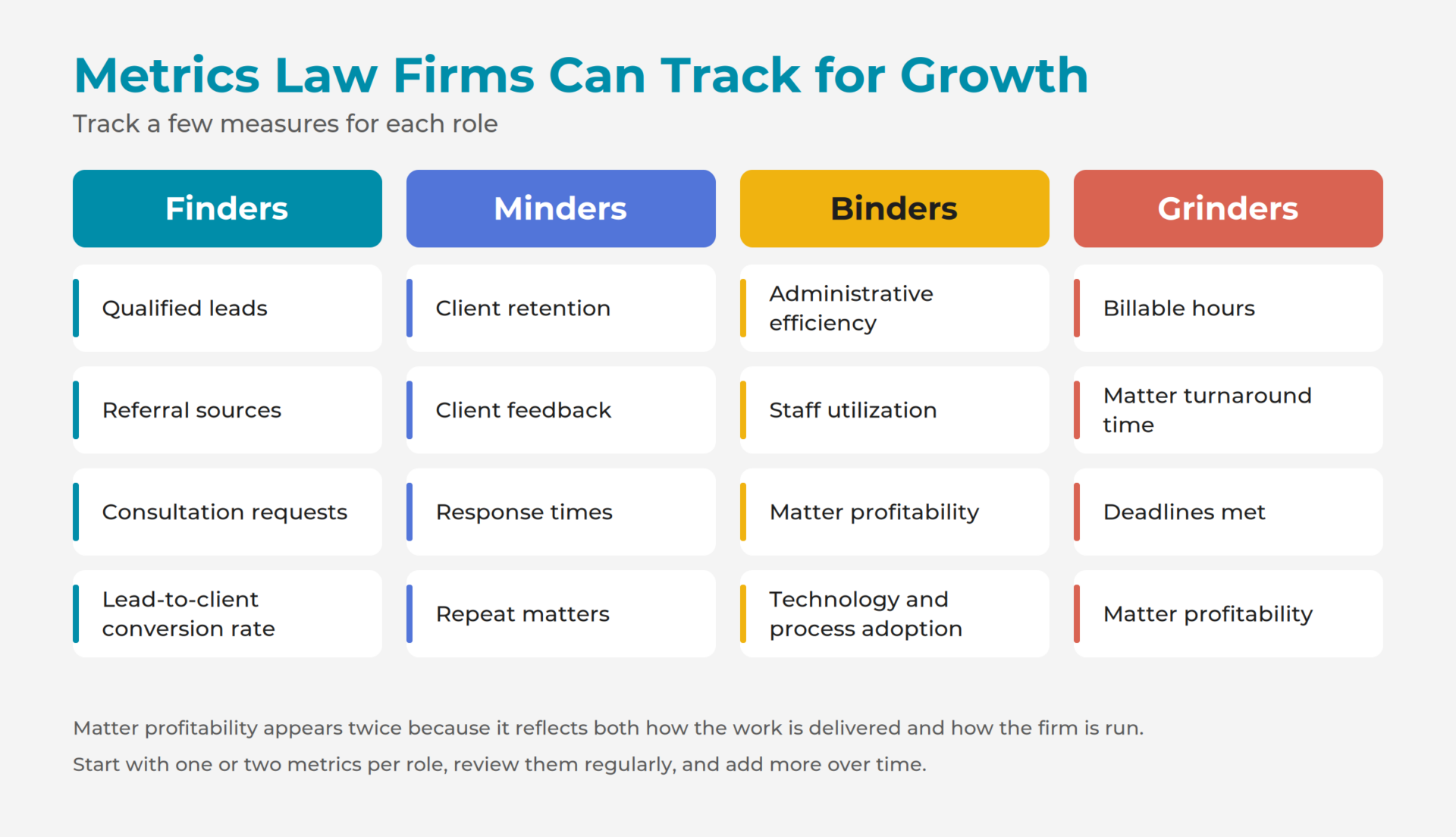
You don’t need to track everything at once. Start with one or two metrics per role, review them regularly, and add more as your reporting matures. Matter profitability appears under both binders and grinders because it reflects both how efficiently the work is delivered and how well the firm is run.
Are Finders, Binders, Minders and Grinders Separate People?
Not necessarily. The framework describes functions, not headcount. A solo attorney may act as:
- Finder: Networking and marketing the practice.
- Minder: Keeping in touch with clients.
- Grinder: Doing the legal work.
- Binder: Managing billing, scheduling, and systems.
As the firm grows, these responsibilities become more distributed among attorneys, marketing professionals, legal support staff, and operations teams. The goal isn’t to create four departments. It’s to make sure all four functions are getting attention, whoever is doing the work.
Many firms fill the finder gap by bringing in outside help, such as outsourced marketing or fractional marketing services, rather than adding a full-time hire before they’re ready.
Building a Balanced Law Firm Growth Strategy
Sustainable growth comes from aligning the whole firm, not just the front door:
- Marketing creates visibility.
- Business development creates opportunities.
- Client management strengthens relationships.
- Legal teams deliver the service.
- Operations create the infrastructure for sustainable growth.
Start by looking honestly at which of the four roles is strongest and which needs support. Then build a plan that strengthens the weak spots without neglecting the strong ones. If you’d like help with the finder side, learn more about marketing for law firms from PSM Marketing.