

A press release boilerplate is a short, standardized paragraph at the end of a press release that describes the organization behind the announcement. It answers a simple question a journalist may have after reading the news: Who is this company, and what does it do?
Organizations include a boilerplate because reporters, editors, and bloggers often work quickly. A well-written boilerplate gives them reliable background information without a search, and it keeps the organization’s description consistent every time it appears in the media. For professional PR teams, and for law firms building visibility through law firm marketing, it is one of the most useful and least glamorous parts of a release.
What Is a Boilerplate for a Press Release?
A boilerplate is a brief “about the organization” statement, usually one short paragraph. It typically appears at the end of the release, after the body text and quotes, and before the media contact details. Many releases label it with a heading such as “About [Organization Name].”
The main content of a press release is about news: a new hire, a product launch, an event, a court victory, a community initiative. The boilerplate is about the organization. The body changes with every announcement, while the boilerplate describes the organization in general terms and usually stays the same from release to release.
That consistency matters. When a journalist sees the same description across several announcements, it reinforces the organization’s identity and reduces the chance of errors. It also saves your team from rewriting the same background paragraph every time.
What Information Should a Press Release Boilerplate Include?
A strong boilerplate covers the essentials without turning into a sales pitch. Consider including:
- Organization or law firm name: Use the full, correct name at least once.
- What the organization does: State it plainly, such as “a full-service personal injury law firm” or “a nonprofit that provides legal aid.”
- Main services or areas of practice: Focus on the core offerings rather than every service.
- Location or geographic reach: Note the city, state, region, or the areas served.
- Years in business, when relevant: “Founded in 2005” or “serving clients for more than 20 years” can add credibility if it’s accurate.
- Notable credentials or professional affiliations: Bar association memberships, certifications, or recognized industry affiliations that can be verified.
- Website: Always include the URL so journalists can find more information.
- Contact information, if appropriate: Some organizations place this in the boilerplate, while others list it separately in a media contact section.
What Should You Leave Out of a Boilerplate?
Journalists are wary of promotional copy, so a boilerplate works best when it reads like a factual summary. Leave out:
- Excessive promotional language. Phrases like “world-class” or “unparalleled” read as advertising, not information.
- Unverified claims. Every statement should be something you could back up if asked.
- Long lists of accomplishments. Awards and case results belong on your website or in a separate media kit.
- Outdated statistics. A number that was true three years ago can undermine your credibility today.
- Unrelated information. Stay focused on the organization itself.
- “Best” or “leading” claims without objective support. If you use these words, be prepared to cite a specific, verifiable source. For law firms, this is especially important, because advertising rules in many jurisdictions restrict misleading or unverifiable claims. Check your local bar rules.
How Long Should a Press Release Boilerplate Be?
Most boilerplates run between 50 and 100 words, or roughly three to five sentences. Short is better because journalists want the key facts quickly, and editors often trim or lift only a sentence or two.
Some situations justify a longer description, such as a complex organization with several divisions, a nonprofit with a detailed mission, or a firm with multiple offices and distinct practice groups. Even then, keep it tight.
To prioritize, ask what a reporter who has never heard of you needs to know. Lead with the name and core function, then add the market or location, then credentials and the website. If something doesn’t help a journalist understand who you are, cut it.
How to Write a Boilerplate Media Release
Whether you call it a press release or a media release, the boilerplate works the same way. Here’s a simple process:
- Start with the organization’s name. Use the full legal or official name, and note any shortened name you’d like used afterward.
- Explain what it does. Use one clear sentence that a non-specialist could understand.
- Identify the primary audience or market. Who do you serve, and where?
- Mention relevant experience or credentials. Include only what you can verify.
- Add the website. Place it at the end so it’s easy to find.
- Review and update regularly. Check it against your current services, locations, and leadership before each release goes out.
Then read it aloud. If it sounds like an advertisement, revise it.
Boilerplate Example for a Law Firm
Here is an informational example. Replace the bracketed details with your firm’s verified information:
About [Firm Name]
[Firm Name] is a [city, state]-based law firm representing individuals and families in [practice area 1], [practice area 2], and [practice area 3]. Founded in [year], the firm serves clients throughout [county/region/state] and is committed to providing clear communication and personalized legal guidance. Its attorneys are members of the [State] Bar Association and [relevant professional organization]. For more information, visit [www.firmwebsite.com].
Notice what the example does not do. It doesn’t claim to be the “best” firm, promise outcomes, or cite unverifiable results. It describes practice areas, geographic reach, experience, and client focus in neutral, factual language.
Solo and small firms can use the same structure. Just keep the description short and factual, and make sure it matches the positioning in your broader solo and small law firm marketing.
How a Boilerplate Fits Into a Press Release Format
Press releases follow a fairly standard structure, which helps journalists scan them quickly. A typical format looks like this:
- Headline: A concise, informative summary of the news.
- Dateline: The city and date, often at the start of the first paragraph.
- Introduction/lead: The who, what, when, where, and why in the opening paragraph.
- Supporting details: Background and context that expand on the lead.
- Quotes: Statements from executives, attorneys, clients, or partners.
- Additional information: Relevant facts, links, or event details.
- Call to action/contact information: What readers should do next, such as register, visit a page, or reach out for an interview.
- Boilerplate: The standardized organizational description.
- Media contact: The name, email, and phone number for press inquiries.
Many releases end with “###” or “-30-” to signal that the release is complete. The exact order of the final sections can vary slightly, but the boilerplate almost always comes after the news content.
Press Release Format and AP Style
AP Style comes from The Associated Press Stylebook, a widely used guide for news writing. It isn’t a specific “press release format.” It’s a broader set of writing conventions that many PR professionals follow so their releases read like news copy. The structure described above is the format, and AP Style governs the language within it.
Relevant AP considerations include:
- Clear, concise writing: Short sentences and plain words. Avoid jargon.
- Dates and numbers: In general, spell out numbers one through nine and use numerals for 10 and above. Abbreviate certain months (Jan., Feb., Aug., Sept., Oct., Nov., Dec.) when used with a specific date, but spell out March, April, May, June, and July.
- Abbreviations: Spell out an organization’s name on first reference, and use an abbreviation later only if it will be clear to readers.
- Professional titles: Capitalize formal titles directly before a name (Managing Partner Jane Smith) and lowercase them when they follow the name or stand alone (Jane Smith, managing partner).
- Avoiding unnecessary promotional language: AP Style favors factual, neutral wording, which suits boilerplates well.
- Consistent capitalization and punctuation: Apply the same rules throughout, including in the boilerplate.
Since the stylebook is updated periodically, check the current edition when in doubt.
How Often Should You Update a Boilerplate?
Review your boilerplate at least once or twice a year, and update it whenever something changes materially. Common triggers include:
- Services change
- Locations change, or offices open or close
- Leadership changes
- The organization reaches a significant milestone
- Practice areas are added or removed
- Contact information changes
- Outdated claims or statistics need to be removed
A quick check before each release is a good habit. An outdated boilerplate can send journalists to the wrong address or misrepresent what you do.
Why Boilerplates Matter in Law Firm Marketing
For law firms, PR is about building trust and visibility with the media, the community, and prospective clients. A boilerplate supports that effort in several ways:
- It provides consistent firm information across every announcement.
- It saves time when your team is producing multiple releases.
- It helps journalists understand the firm quickly, which makes coverage more accurate.
- It reinforces the firm’s positioning by describing practice areas and focus in the same terms each time.
- It creates consistency across PR materials, including media kits, bios, and speaker introductions.
If you’re building a broader visibility plan, a polished boilerplate pairs well with a documented law firm marketing strategy and other efforts such as attorney bios, thought leadership content, and a well-organized law firm website. Press coverage also supports your online presence, since consistent, credible mentions can strengthen SEO efforts over time.
Boilerplate vs. About Us Section: What’s the Difference?
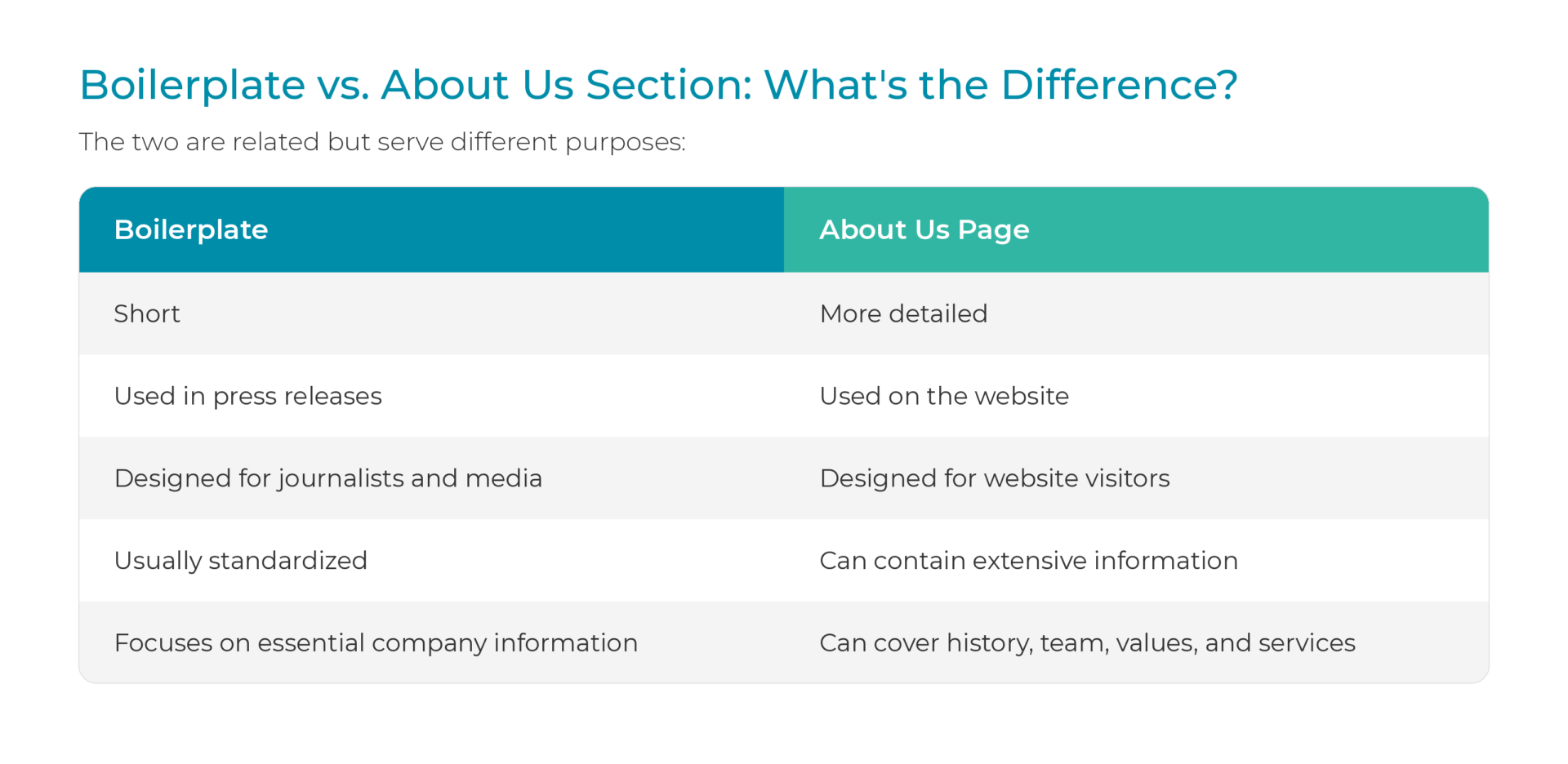
Think of the boilerplate as a summary and the About Us page as the full story. Many organizations draft the About Us page first, then distill it into a boilerplate.
Final Thoughts
A boilerplate for a press release is a small piece of writing that does important work. Keep it short, factual, and current, avoid unsupported claims, and use it consistently. For law firms in particular, it’s a simple way to present a professional, credible identity to the media every time you publish news. If you’d like help with the bigger picture, learn more about marketing for law firms from PSM Marketing.


